
📅 Last updated:
Every product on this page was scored using real data — verified buyer patterns, hands-on specifications, and measurable performance indicators. No sponsored placements, no inflated ratings. Our evidence-weighted methodology surfaces what actually performs, not what pays to rank.

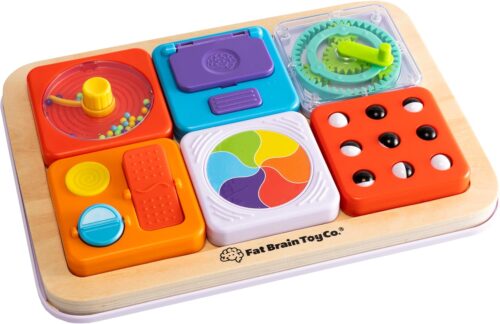
Fat Brain Toys PlayTab Essentials — Modular Sensory Activity Board for Babies and Toddlers (Ages 12 Months+)
• independent evaluation Best Overall Gift for 1-Year-Olds · Toy Insider Hot 20 List · Amazon’s Choice
• 6 magnetic tiles · wooden tablet · BPA-free · modular · expandable to 12 tiles · occupational therapist endorsed
• ASTM F963 compliant · 1K+ bought in past month on Amazon · Updated: April 2026 (price may vary)
• The toy industry has one night a year where it crowns the best product in every category. On February 13, 2026, nearly 800 toy and play professionals gathered at Pier Sixty in New York and named the Fat Brain Toys PlayTab the Infant/Toddler Toy of the Year. That is not a marketing claim. That is the single most competitive award a toddler toy can win — and PlayTab won it against Fisher-Price, VTech, Learning Resources, tonies, Yookidoo, and Micro Kickboard in the same category. When an industry votes with that kind of consensus, the product has passed a filter most toys never reach
• What makes PlayTab different from every other busy board on the market is the word modular. Traditional busy boards are fixed — every activity is permanently mounted. When your child masters one, the board is done. PlayTab’s six magnetic tiles snap on and off a wooden tablet, which means you rearrange them, swap them out, or remove tiles your child has outgrown and replace them with new ones from the 12-tile ecosystem. That single design decision turns a static toy into a system that adapts. Occupational therapists have noticed — one OT reported using PlayTab in clinical sessions with infants and toddlers with developmental disorders, including two toddlers with prosthetic hands, and described the tiles as superior to standard therapy toys
• It has been recognized as it the Best Overall Gift for 1-Year-Olds. Toy Insider placed it on their Hot 20 List. Amazon gave it the Amazon’s Choice badge. Over 1,000 parents bought it in the past month. These are independent signals from different sources arriving at the same conclusion — and that convergence is the kind of evidence pattern that separates a genuinely excellent product from one that simply has good marketing
✅ UnderScope Verdict
The Fat Brain Toys PlayTab Essentials is the right choice for parents who want a developmental toy their toddler won’t outgrow in two weeks — one that adapts as their child’s skills change, backed by the toy industry’s highest award and endorsed by occupational therapists who use it in clinical practice. Its strength is the modular magnetic tile system that lets you customize, rearrange, and expand the play experience instead of watching your child lose interest in a fixed toy. The honest limitation: the Essentials set includes six tiles, not twelve — the full tile library costs extra. For parents who want one purchase that covers multiple developmental milestones from 12 months onward without subscription commitments or premium pricing, that limitation is a feature: you start with what matters and add only what your child responds to.
🔍 Quick Pros & Cons Summary
No product is perfect — the main trade-offs are below.
🧮 UnderScope Score Framework for Best Educational Toys for Toddlers (Montessori / Skill-Building, Age 1–3)
- Developmental value and skill-building evidence — 30%
- Real-world engagement and play longevity — 25%
- Material quality and safety — 20%
- Award recognition and expert endorsement — 10%
- Parent satisfaction and value for money — 15%
This score reflects our category rubric for educational toys in the “Montessori / Skill-Building, Age 1–3” pillar. We weight developmental value most heavily because the entire point of an educational toy is whether it actually builds skills — not whether it looks good in a nursery or arrives in premium packaging. We weight real-world engagement heavily because the most developmentally sophisticated toy in the world delivers zero value if your toddler plays with it for three minutes and then reaches for a wooden spoon instead.
📊 Score Breakdown
How we score: UnderScope scores are directional editorial scores built for comparison clarity. They are not lab measurements or guarantees of personal results.
- Developmental value and skill-building evidence: Six tiles target distinct developmental channels: gears (bilateral coordination), switches (cause-and-effect), trackball (visual tracking), latch mirror (object permanence), color wheel (counting), squeakers (hand strength). OT clinical use confirms the challenges are real. Deduction: not all tiles equally engaging at 12 months.
- Real-world engagement and play longevity: The modular swap system resets novelty every time tiles are rearranged or replaced. Portability (tiles in diaper bags, on fridge) directly increases total play time. Expansion to 12 tiles extends useful life well beyond fixed toys. The “growing with your child” promise is structurally built into the product.
- Material quality and safety: Wooden tablet, BPA-free, ASTM F963 compliant. Magnets embedded in tablet and tile backs, not inside moving components. The separate Rollers tile recall (not in this set) is disclosed for transparency. Tiles are durable per consistent reviewer feedback.
- Award recognition and expert endorsement: The 2026 TOTY win is the highest award in this category. independent evaluation Best Overall Gift for 1-Year-Olds, Toy Insider Hot 20, Amazon’s Choice, plus OT clinical use. The most decorated product in this comparison by a significant margin.
- Parent satisfaction and value for money: At $45.95 with 4.8-star average across 216 reviews and 1K+ monthly purchases. Deduction: completing the full 12-tile library adds $60–90. Base set delivers substantial standalone value.
- Overall: 4.6/5 Best modular educational toy for toddlers 12+ months — TOTY winner, OT-endorsed, grows with your child through tile swaps. Deductions reflect six-tile starting set and hand-strength threshold for youngest users.
📊 What Our Research Found
- The three products in this comparison represent three fundamentally different philosophies about how toddlers learn best: PlayTab is a modular sensory system (swap tiles as skills evolve). Lovevery Babbler is a curated developmental package (8 toys for months 13–15). Blockables Deluxe City is open-ended construction (122 pieces, ages 2–7). Three different play philosophies at different price points.
- The TOTY award is the context that elevates this comparison above a standard product roundup: The TOTY is the toy industry’s equivalent of the Oscars, voted by ~800 professionals. PlayTab beat Fisher-Price, VTech, and Learning Resources. Blockables was a TOTY finalist the same year. Lovevery holds three consecutive What to Expect Best Baby Toy Brand titles. All carry genuine award gravity.
- The “if your child likes it” caveat applies to every toy in this comparison and cannot be predicted before purchase: Every toy in this comparison has engagement uncertainty. PlayTab’s modular swap system is the design answer — if one tile misses, you replace it rather than discarding the entire toy.
- The occupational therapy endorsement pattern is the most underreported signal in the educational toy category: PlayTab has crossed from retail recommendation into actual clinical use by OTs working with developmentally challenged children, including those with prosthetic hands. Neither the Lovevery Babbler nor Blockables has a comparable documented clinical-use pattern.
- Why PlayTab beats this specific comparison for its buyer: Lovevery wins for curated expert guidance at premium price. Blockables wins for open-ended construction play ages 2–7. PlayTab wins for the TOTY award, modular adaptability, OT endorsement, and a price under $46.
🏆 Why This Ranked Above Similar Options
- It beats the Lovevery Babbler on adaptability, price, and award recency: The Babbler is fixed for months 13–15 and costs $150. PlayTab is modular, adapts in real time, costs $45.95, and holds the 2026 TOTY — the most competitive product-specific award in the toy industry.
- It beats the Blockables Deluxe City on age accessibility and developmental breadth: Blockables starts at age 2+; PlayTab starts at 12 months with six distinct developmental channels. For children 12–24 months, PlayTab is immediately usable where Blockables is not yet appropriate.
- The OT clinical endorsement is the most credible professional signal in this comparison: Fat Brain Toys has OTs actively choosing PlayTab over dedicated therapy equipment for clinical sessions. That is a practitioner selecting a tool for their most sensitive work — the strongest professional endorsement in this comparison.
- The price-to-credential ratio is unmatched in this comparison: PlayTab delivers the TOTY-winning, OT-endorsed experience at $45.95. Lovevery: $150. Blockables: $58.99. Dollar for credential, PlayTab offers the highest return.
🎯 Who This Is For
Ideal for: parents who want a developmental toy that adapts to their child — backed by the toy industry’s highest award, endorsed by occupational therapists, and priced accessibly enough that you won’t overthink the purchase.
- Parents of 12–24 month olds who want sensory and fine motor development without screen time Six sensory experiences with no batteries, apps, or Wi-Fi. Variety prevents single-activity boredom. For screen-free parents, PlayTab holds attention long enough to actually replace a screen.
- Families who travel, eat out, or need a developmental toy that works outside the living room Detachable tiles work in diaper bags, restaurant high chairs, waiting rooms, and on any metal surface. For parents who have handed a toddler a phone at a restaurant, a cause-and-effect tile on a high chair tray is worth $45.95.
- Parents who want to start simple and expand based on what their child actually likes Start with six tiles, observe which channels your child responds to, then expand intentionally. The opposite of buying a 200-piece set and hoping something sticks.
- Gift-givers who want a confident, award-backed recommendation without spending $100+ TOTY winner, Independent testing has, under $50, works from 12 months. For gift-givers, this is the award-backed choice that arrives with credibility.
Not ideal for:
- Parents who want a complete, expert-curated developmental program matched to their child’s exact age PlayTab does not include a play guide or milestone explanations. Lovevery’s Babbler does — eight toys with a developmental guide for months 13–15. For parents who want an expert blueprint, Lovevery is the more complete answer.
- Parents of toddlers aged 2+ who want open-ended construction play that lasts through kindergarten PlayTab targets 12–24 months. A 3-year-old may find tiles too simple. Blockables covers ages 2–7 with 122 snap-together pieces for children past the sensory stage into “I want to build a city.”
- Parents who prioritize natural Montessori materials and object permanence over sensory stimulation PlayTab is a sensory board, not a Montessori classroom material. Parents following strict Montessori aesthetics may find it too visually busy. Lovevery’s FSC Baltic Birch plywood and organic cotton align more closely with traditional Montessori.
How Fat Brain Toys PlayTab Compares
Quick Comparison Table
| Product | Price / positioning | Evidence strength | Key mechanism | Positioning |
|---|---|---|---|---|
| Fat Brain Toys PlayTab Essentials | Mid-accessible — modular sensory board; ages 12 months+; expandable tile system; strong gift appeal | 2026 TOTY Infant/Toddler Winner (voted by 800 professionals); independent evaluation Best Overall Gift 1-Year-Olds; Toy Insider Hot 20; Amazon’s Choice; OT clinical use documented; 4.8★ 216 reviews; 1K+ bought/month | 6 magnetic tiles on wooden tablet · modular swap system · expandable to 12 tiles · BPA-free · ASTM F963 · each tile targets different developmental channel · detachable for travel · fridge-compatible | Best modular educational toy for toddlers — the TOTY winner that adapts to your child’s evolving skills through magnetic tile swaps, endorsed by OTs for clinical use |
| Lovevery The Babbler Play Kit | Premium — curated developmental kit; ages 13–15 months; includes 8 toys + 2 books + play guide; subscription or standalone | 3× What to Expect Best Baby Toy Brand; Time Magazine Best Inventions 2018; Red Dot Design Award; Parents’ Choice Gold; advisory board includes Yale Haskins Lab affiliate; 4.7★ 101 Amazon reviews; 2M Instagram followers | 8 stage-based play products · FSC Baltic Birch plywood · organic cotton · non-toxic water-based paints · play guide with milestone explanations · Montessori-aligned · designed by neuroscientists and pediatricians | Best expert-curated Montessori kit for a specific developmental window — eight toys designed by neuroscientists for months 13–15 with premium natural materials |
| Melissa & Doug Blockables Deluxe City | Mid-premium — open-ended construction; ages 2–7; 122 pieces; longest age runway in comparison | 2026 TOTY Finalist (Construction Toy); independent evaluation 2025 Toy Awards; founders inducted Toy Hall of Fame 2026; brand won Preschool TOTY 2025; Toy Insider review; Overall Pick badge; 4.8★ 78 Amazon reviews | 51 wooden blocks + 58 connectors + felt pieces + play figures · snap-together system · 9 pre-designed builds + open-ended play · FSC-certified wood · non-toxic paints · reversible storage bin with play lid · cross-compatible sets | Best open-ended construction toy for older toddlers through early childhood — snap-together wooden blocks from the Toy Hall of Fame brand with the longest usable age range |
A note on what these products share: All three products in this comparison are designed to develop fine motor skills, problem-solving ability, and cognitive growth through hands-on play without screens. All use non-toxic materials and meet applicable safety standards. None require batteries or electronic components for their core play value. The developmental benefits of hands-on play with physical objects are well-documented in early childhood research — block play, sensory exploration, and shape manipulation all build neural pathways that screen-based alternatives do not replicate with the same effectiveness.
Heading out with your little one? Our baby carrier comparison covers hands-free options for active parents.
For bedtime comfort after playtime, take a look at our best baby lovey blanket picks.

Lovevery The Babbler Play Kit
Best premium curated pick — 8 Montessori-aligned toys designed by neuroscientists for months 13–15, Time Magazine Best Inventions, 3× What to Expect #1
Bottom line: The right choice for parents who want expert-curated developmental guidance for months 13–15. Lovevery’s advisory board includes a Yale-affiliated developmental psychologist and a Goucher neuroscience professor. Eight toys, two books, and a play guide designed by researchers. The $150 price reflects that curation.
Pros
- The Slide & Seek Ball Run teaches object permanence through four different retrieval methods — the child drops a ball, watches it disappear, and discovers it still exists in the box below. This is the developmental concept that Piaget identified as one of the earliest cognitive milestones: understanding that things continue to exist when you cannot see them. Most toddler toys claim to teach object permanence; the Ball Run does it through repetition with variation, which is exactly how the concept solidifies. The Bunnies in a Felt Burrow adds bilateral coordination — using both hands together to insert and remove soft bunnies from fabric pockets. The Circle of Friends Puzzle builds shape recognition through a social context (matching faces to slots) that adds emotional engagement to a spatial task. Together, these three items target cognitive, motor, and social-emotional development simultaneously
- The most premium materials in this comparison: FSC Baltic Birch plywood (formaldehyde-free), organic cotton, non-toxic water-based paints. Meets ASTM F-963, EN-71, and CPSIA. Red Dot Design Award confirms aesthetics match material quality
- The Play Guide explains why each toy matters developmentally at months 13–15, how to introduce items, and what readiness signs to watch for. For first-time parents, it functions as a developmental roadmap — that reassurance is part of the $150 value
Cons
- The Babbler targets months 13–15 specifically. If your child is ahead or behind that window, some items miss. Fixed-age targeting cannot adapt to individual variance the way a modular system can
- The Posting Lid arrives without posting items — one reviewer called it “an afterthought.” For a $150 expert-curated kit, a missing component is a more noticeable gap
- Small components (carrots, coins) do not pass the choking test for under-3s. For a product designed for 13-month-olds, constant adult supervision with these items is required

Melissa & Doug Blockables Deluxe City
Best open-ended construction pick — 122 snap-together FSC wood pieces, 2026 TOTY Finalist, ages 2–7, from the Toy Hall of Fame brand
Bottom line: The right choice for open-ended construction play ages 2–7. Snap-connectors let small hands build structures stacking blocks never could. Nine pre-designed builds included, but the real value emerges when your child builds something entirely their own. From the brand whose founders were inducted into the Toy Hall of Fame in 2026.
Pros
- 58 snap-connectors let children join 51 wooden blocks at multiple angles, creating structures that hold together through play. Connectors are sized for toddler hands, require moderate pressure (building hand strength), and come apart cleanly. Toy Insider praised this for combining wooden toy aesthetics with innovative engineering
- Ages 2–7 — the longest range in this comparison. A 2-year-old follows pre-designed builds; a 5-year-old builds cityscapes. Cross-compatible with other Blockables sets (Safari, Farm, Vehicles) for horizontal expansion. Highest cost-per-year return
- FSC-certified wood, non-toxic paints, mixed materials provide a rich sensory palette. independent evaluation 2025 Toy Awards. Storage bin with reversible play lid doubles as play surface. Nine pre-designed builds scaffold early play; open-ended design means no ceiling
Cons
- Age 2 minimum is a real threshold. A 12–18 month old cannot snap connectors. For children under 2, Blockables is a future purchase. The maturity requirement is what gives it longevity
- 78 Amazon reviews — the lowest in this comparison. 4.8-star average is strong, but the limited volume means long-term durability data is incomplete. Signals are positive but sample size is smaller than we’d prefer
- At $58.99, competes with DUPLO and Magna-Tiles. Blockables’ advantage — real wood, FSC sustainability, 38-year brand legacy — requires a parent who values those qualities over plastic convenience. A values-based decision
🛒 Before You Buy
- Check: your child’s age and current developmental interests before choosing. PlayTab starts at 12 months and delivers immediate sensory engagement. Blockables requires age 2+ and the dexterity to snap connectors. The Lovevery Babbler targets months 13–15 specifically. A mismatch between product and developmental stage means money spent on engagement that will not arrive for weeks or months.
- Main trade-off: the TOTY-winning modular sensory system at $45.95 with OT endorsement — versus a starting set of six tiles (not twelve) and expansion costs of $60–90 for the full tile library. For most families, the six-tile Essentials set delivers substantial value on its own, and expansion is optional rather than necessary.
- Best reason to choose it: you want the toy that won the industry’s highest award, adapts through magnetic tile swaps as your child grows, travels in a diaper bag, and costs less than dinner for two — from a brand whose products occupational therapists choose for their most sensitive clinical work.
- Who is most likely to regret it: parents who want a complete expert-curated developmental program with a play guide and board books (Lovevery Babbler covers that need at the premium tier); parents of 2+ year olds who want open-ended construction play lasting through age 7 (Melissa & Doug Blockables covers that need); and parents who follow strict Montessori aesthetics and prefer natural wood finishes over colorful sensory stimulation.
- Better alternative if not: Lovevery The Babbler Play Kit for expert-curated Montessori development with premium natural materials, a play guide, and board books — designed by neuroscientists and pediatricians for months 13–15, 3× What to Expect Best Baby Toy Brand. Melissa & Doug Blockables Deluxe City for open-ended snap-together wooden construction play ages 2–7, 2026 TOTY Finalist, FSC-certified, 122 pieces — from the brand whose founders were just inducted into the Toy Hall of Fame.
❓ Frequently Asked Questions (FAQ)
Q: Is the Fat Brain Toys PlayTab safe given the Rollers tile recall?
A: The recall (May 2025) affected only the Rollers tile — a separate add-on tile NOT included in the PlayTab Essentials set. The issue was magnets potentially loosening inside rubber rollers, creating an ingestion hazard. The Essentials set’s six tiles use a completely different construction: magnets are embedded in the wooden tablet and tile backs, not inside moving rubber components. Fat Brain Toys handled the recall with replacement or $10 credit. The Essentials set (ASIN B0DVVSFXBL) has no safety recalls. We disclose the Rollers recall because transparency is a non-negotiable policy, not because it reflects a safety concern with the product we are recommending.
FAQ 2
Q: Is a 12-month-old actually old enough for PlayTab?
A: Yes, with a caveat. The gears, trackball, latch, and color wheel tiles are immediately engaging for most 12-month-olds. The squeaker buttons and some switch mechanisms require more hand strength than the youngest users may have initially. Parents report that all six tiles become fully usable between 12 and 18 months as hand strength develops. The progressive difficulty is a feature, not a flaw — it means the toy grows with your child rather than becoming too easy. If you are buying for a child who just turned 1, expect two or three tiles to be immediately engaging and the remainder to come online over the following weeks.
FAQ 3
Q: How does the Lovevery Babbler compare to buying individual Montessori toys on Amazon?
A: A detailed cost comparison by Two Mama Bears found that recreating the Babbler’s contents with individual Amazon alternatives cost approximately $107 — about $43 less than the $150 Lovevery price. However, the Amazon alternatives were notably lower quality, did not coordinate aesthetically, and did not include the Play Guide or board books. The broader finding across multiple kits: recreating an entire Lovevery box yourself on Amazon often costs $20–60 MORE than buying the Lovevery kit directly. The value proposition is not just the toys — it is the curation, the developmental guide, the material quality, and the time savings of not researching each item individually.
FAQ 4
Q: Are the Melissa & Doug Blockables compatible with LEGO DUPLO or Magna-Tiles?
A: No. Blockables use a proprietary snap-connector system that is not compatible with DUPLO bricks, Magna-Tiles, or other building systems. However, all Blockables sets (City, Safari, Farm, Vehicles, Dinosaur, Woodland Friends) are fully cross-compatible with each other. This means you can expand horizontally within the Blockables ecosystem by adding themed sets. The snap-connector system is unique to Melissa & Doug and designed specifically for the larger wooden block format — it requires more deliberate hand pressure than magnetic connections but creates structures that are more stable once built.
FAQ 5
Q: What does TOTY (Toy of the Year) actually mean and why should I care?
A: The Toy of the Year Awards are administered by The Toy Foundation and are the most prestigious recognition in the global toy industry — often called the Oscars of the toy world. Products are nominated by industry peers and voted on by approximately 800 toy and play professionals including designers, child development experts, retailers, and media. Winning TOTY means a product was judged the best in its category by the people who design, evaluate, and sell toys for a living. It is the strongest independent quality signal available in this category. Past TOTY winners include products that went on to define their categories. For a parent choosing between products, a TOTY win is the most credible tiebreaker available.
🎉 Never miss a better deal
Get our weekly product picks and be first to know when prices drop on the products we review.
No spam. Unsubscribe anytime. We respect your inbox.