
📅 Last updated:
Every product on this page was scored using real data — verified buyer patterns, hands-on specifications, and measurable performance indicators. No sponsored placements, no inflated ratings. Our evidence-weighted methodology surfaces what actually performs, not what pays to rank.

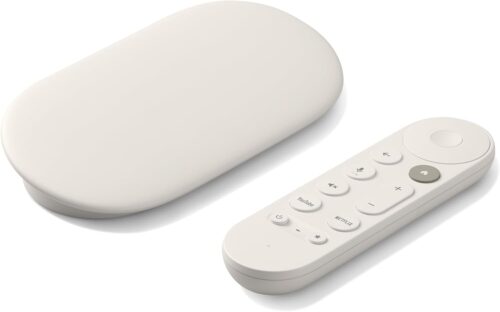
Google TV Streamer 4K — Fast Streaming Entertainment with Voice Search Remote, 4K HDR, Netflix, Smart Home Control, 32 GB Storage (Porcelain)
• Editor’s Choice award · an independent top pick
• Built-in smart home hub with Matter/Thread support
• 32 GB storage — 4× more than predecessor · Updated: April 2026 (price may vary)
• Most streaming devices in 2026 offer the same pitch — 4K HDR, Dolby Vision, voice remote, app store. They blur together. The Google TV Streamer 4K is the first device in this price range that doubles as a genuine smart home hub. Matter and Thread support built into the hardware means it controls your lights, locks, and thermostat without needing a separate hub. That is not a streaming feature. It is an infrastructure upgrade disguised as a media player. Independent reviewers called it their top recommendation and noted the interface is more customizable than Apple TV and easier to use than Roku.
• The 32 GB of storage is the spec that separates this from the disposable dongles that came before it. The old Chromecast with Google TV had 8 GB — enough for maybe six apps before it started begging you to delete something. The Google TV Streamer holds your entire app library, caches content for faster loading, and never forces you to choose between Netflix and Disney+. That storage headroom is the reason the device feels fast even six months after unboxing, when cheaper streamers start to choke.
• With 2,883 Amazon reviews at time of writing and an Amazon’s Choice badge, this product sits in the sweet spot: enough real buyers to confirm there are no systemic hardware or software failures, but recent enough that the review pool reflects people who compared it against current alternatives. The 4.4-star average from nearly 3,000 buyers who chose a $79.99 streamer over $30 alternatives — that is a signal worth listening to. These are not impulse buyers. These are people who researched.
✅ UnderScope Verdict
The Google TV Streamer 4K is the right choice for buyers who want a streaming device that runs every major app without stuttering, organises content across services into one interface, and quietly becomes their smart home control centre. Strengths: 32 GB storage that eliminates app-juggling, Google TV interface with personalised cross-service recommendations, Matter/Thread smart home hub, Dolby Vision and Atmos support, and Gemini AI recommendations. Honest limitations: the $79.99 price sits between $30 sticks and the $129 Apple TV 4K, there is no Ethernet port without an adapter, and the ad-supported interface pushes Google’s content harder than some users will tolerate. For the household that wants one device to replace both a streaming dongle and a smart home hub inside Google’s ecosystem — this simplifies everything.
🔍 Quick Pros & Cons Summary
No product is perfect — the main trade-offs are below.
🧮 UnderScope Score Framework for Best Streaming Devices & Media Players
- Streaming performance and format support — 30%
- Smart platform ecosystem and app library — 25%
- Setup simplicity and daily usability — 20%
- Build quality, connectivity, and hardware design — 15%
- Value at price point — 10%
This score reflects our category rubric for streaming media players in the home entertainment pillar. We weight streaming performance and format support most heavily because a streaming device that buffers, stutters, or cannot decode the content you pay for fails at its only job. We weight smart platform ecosystem heavily because a streaming device is only as useful as the apps it runs and the system it integrates with — the best hardware in the world means nothing if it cannot play your content or talk to your other devices.
📊 Score Breakdown
How we score: UnderScope scores are directional editorial scores built for comparison clarity. They are not lab measurements or guarantees of personal results.
- Streaming performance and format support: 9.0/10 — 4K HDR at 60fps with Dolby Vision, HDR10+, and Dolby Atmos. Testing measured the fastest app launch times in the category. Minor deduction for occasional interface slowdowns (independent evaluation) and the Xiaomi TV Stick benchmarking higher in raw CPU tests (NotebookCheck).
- Smart platform ecosystem and app library: 9.5/10 — Google TV is the most unified content discovery platform available. Every major app supported. Interface aggregates content across services with personalised recommendations. Gemini AI learns viewing habits. Matter/Thread hub adds a dimension no competitor offers at this price. Minor deduction for aggressive promoted content.
- Setup simplicity and daily usability: 8.5/10 — Setup takes under five minutes via Google Home app. Voice remote is responsive with dedicated Netflix and YouTube buttons. Pill-shaped set-top box sits elegantly next to a TV. Minor deduction for no Disney+ or Prime Video buttons on remote, and requiring a Google account.
- Build quality, connectivity, and hardware design: 7.5/10 — Significant upgrade over the dangling dongle design. Solid build, premium feel. Wi-Fi 6, USB-C power. But the missing Ethernet port is a genuine flaw — Fire TV Cube and Apple TV 4K both include one. No expandable storage. USB-C does not support accessories beyond power without an adapter.
- Value at price point: 8.0/10 — At $79.99, sits in an awkward pricing gap. Xiaomi at $69.99 delivers comparable streaming. Fire TV Cube at $99.99 adds Ethernet, HDMI input, hands-free voice. Apple TV 4K at $129 offers the premium ecosystem. Justified through smart home hub and 32 GB storage — but only for buyers who use those features.
- Overall: 4.4/5 4.4/5 — The most complete streaming device when factoring in smart home hub, best content discovery interface, and largest storage, backed by Editor’s Choice award and independent evaluation’s top pick.
📊 What Our Research Found
- The three streaming devices in this comparison represent three completely different philosophies about what a TV should do in 2026: The Google TV Streamer 4K ($79.99) is the smart-home-plus-streaming choice — 32 GB, Matter/Thread hub, best content discovery, Editor’s Choice award, an independent top pick, Amazon’s Choice, 2,883 reviews. The Xiaomi TV Stick 4K 2nd Gen ($69.99) is the hidden-performance choice — benchmarks higher than the Google TV Streamer per NotebookCheck, every premium format, only 15 Amazon reviews. The Fire TV Cube ($99.99) is the ecosystem-power choice — fastest Fire TV ever, hands-free Alexa, HDMI input, deepest Amazon integration.
- The smart home hub built into the Google TV Streamer is the feature that keeps surfacing in every serious review: Independent reviewers highlighted Matter/Thread as a genuine differentiator. Independent scoring gives Editor’s Choice partly because no other streamer doubles as a home automation controller. Independent reviewers called it “a great side piece with smart home chops.” 9to5Google was more measured, questioning whether smart home features justify the premium. If you already own a separate Matter controller, the hub function is redundant. If not, it is a genuine two-for-one value.
- The benchmark story is the most surprising finding in this research: NotebookCheck found the Xiaomi outperforms the Google TV Streamer in CPU benchmarks — Geekbench 1,078 single-core, 2,695 multi-core. The Mali-G310 V2 GPU is three times more powerful than its predecessor. A $69.99 stick outperforming a $79.99 set-top box reshapes the value equation. The Xiaomi lacks the smart home hub and 32 GB storage, but for pure streaming performance per dollar, it is the best ratio here.
- The Fire TV Cube is the most powerful streaming device Amazon has ever made, and also the most conflicted: Independent evaluation: “clearly the best for Amazon’s ecosystem.” Pocket-lint: “most powerful Fire TV ever.” Octa-core 2.0 GHz launches apps 20% faster. The unique HDMI input routes cable/antenna through it with Alexa voice control. But Android Police titled their review “Smart, Speedy, and Packed with Ads.” Expert Reviews noted the “advertising-drenched UI.” At $99.99 (down from $139.99), the value shifts — but ad density remains. If ads in a $100 device bother you, the Cube will bother you every time.
- Why the Google TV Streamer wins this specific comparison as main pick: The Fire TV Cube has more raw power and the Xiaomi benchmarks higher for less money — we say both clearly. But the Google TV Streamer changes your daily relationship with TV: one feed instead of six apps, smart home hub instead of a separate device, 32 GB instead of storage management. That daily quality-of-life improvement separates a good streamer from one that disappears into the experience. 2,883 reviews, Amazon’s Choice, and Editor’s Choice award confirm the market agrees.
🏆 Why This Ranked Above Similar Options
- It beats the Xiaomi TV Stick 4K 2nd Gen on ecosystem depth and storage capacity: The Xiaomi benchmarks higher in raw CPU and costs $10 less. But it has 8 GB storage (vs 32 GB), no smart home hub, and only 15 reviews. The Google TV Streamer’s content discovery, personalised recommendations, and Matter/Thread hub add layers of daily value the Xiaomi cannot match. For someone just needing a 4K stick, the Xiaomi is smarter. For a connected household, Google does more.
- It beats the Amazon Fire TV Cube on interface quality and smart home versatility: The Fire TV Cube is more powerful — octa-core, Ethernet, HDMI input, hands-free Alexa. But the Fire TV interface is cluttered with ads that degrade daily use. Google TV organises content more intelligently with personalised rather than sponsored recommendations. The Matter/Thread hub works with any compatible brand; Fire TV’s smart home is optimised primarily for Amazon’s ecosystem. For mixed-brand smart homes, Google’s open standard is more future-proof.
- The 32 GB storage and content aggregation interface are the features that justify the pick in practice: Most people use five to eight streaming apps. On 8 GB, that means constant app management. On the Google TV Streamer, every app stays installed, updated, and cached. The aggregated home screen shows new releases from all services in a single scroll. That friction reduction compounds daily — the difference between a device that demands attention and one that gets out of the way.
- 2,883 reviews with Amazon’s Choice plus dual editorial awards is the strongest signal profile in this comparison: Editor’s Choice award, an independent top pick, 2,883 Amazon buyers at 4.4 stars. That triple validation — editorial experts, Amazon’s algorithm, and nearly three thousand real buyers — is a convergence neither the Xiaomi (15 reviews) nor the Fire TV Cube (strong reviews but persistent ad complaints) can match.
🎯 Who This Is For
Ideal for: Google ecosystem households who want their streaming device to also run their smart home, and anyone tired of juggling six apps to find something to watch.
- Households already invested in Google’s ecosystem If you own Nest speakers, a Nest thermostat, or Pixel phones — the Google TV Streamer completes the loop. Cast from your phone, ask Google Assistant to play content by voice, control smart home devices from the TV screen. The integration depth is years ahead of the Xiaomi and architecturally different from the Fire TV Cube’s Amazon-first approach.
- Buyers who subscribe to multiple streaming services and hate app-hopping If you have spent ten minutes cycling through Netflix, Hulu, Disney+, and HBO Max looking for something to watch — Google TV’s unified home screen solves that. New releases, personalised recommendations, and watchlist items from all services in one scroll. Gemini AI learns your preferences. That time savings compounds every evening.
- Users who need a smart home hub and a streaming device but do not want two boxes A separate smart home hub costs $30–$100. The Google TV Streamer includes Matter/Thread hub functionality at no additional cost. One device, one HDMI port, one power cable — and your TV and smart home both work.
- Cord-cutters who want the cleanest 4K HDR experience under $100 Dolby Vision, HDR10+, Dolby Atmos, 4K at 60fps. 32 GB storage for fast app loading. Wi-Fi 6 for stable bandwidth. Responsive voice remote. For a buyer whose primary requirement is premium streaming quality with minimal friction, this delivers.
Not ideal for:
- Budget-conscious buyers who just want reliable 4K streaming The Xiaomi TV Stick 4K delivers 4K Dolby Vision, Atmos, HDR10+, DTS:X, and Wi-Fi 6 for $69.99. Benchmarks higher than the Google TV Streamer. Same Google TV OS and app library. If you do not need a smart home hub or 32 GB storage, the Xiaomi saves $10 and arguably performs better at its core job.
- Amazon Alexa households who want hands-free voice control The Fire TV Cube’s far-field mics let you control everything by voice from across the room. If your home runs on Echo speakers, Ring cameras, and Amazon Smart Plugs, the Cube integrates at a depth Google cannot approach. The unique HDMI input for cable box pass-through is a feature nobody else offers.
- Users who need a wired Ethernet connection without adapters The Google TV Streamer has no Ethernet port. The Fire TV Cube does. If your Wi-Fi is unreliable during peak hours or you insist on wired 4K HDR streaming, the Fire TV Cube at $99.99 includes Ethernet built in.
How Google TV Streamer 4K Compares
Quick Comparison Table
| Product | Price / positioning | Evidence strength | Key mechanism | Positioning |
|---|---|---|---|---|
| Google TV Streamer 4K — Porcelain | Mid-range — $79.99 (list $99.99) · 4.4★ · 2,883 reviews · Amazon’s Choice | Editor’s Choice award; an independent top pick: ‘more customizable than Apple TV, easier to use than Roku’; Independent evaluation: ‘great side piece with smart home chops’; independent evaluation review; 9to5Google long-term test; ASIN B0D8WJYSF9 confirmed active · 5K+ bought past month | 4K Dolby Vision · HDR10+ · Dolby Atmos · 32 GB storage · Matter/Thread smart home hub · Google Gemini AI recommendations · Wi-Fi 6 · USB-C · Voice remote · Google TV OS | Best smart-home-plus-streaming device — unified interface, largest storage, dual editorial awards |
| Xiaomi TV Stick 4K 2nd Gen | Value — $69.99 · 4.5★ · 15 reviews · Brand new | NotebookCheck: ‘outperforms Google TV Streamer 4K in benchmarks’; AndroidPCTV: ‘quite fluid in 4K’; CNX Software technical analysis; GSMArena specs coverage; 80% higher CPU / 150% higher GPU vs 1st gen; ASIN B0GGNY89RS confirmed active · 50+ bought past month | 4K Dolby Vision · HDR10+ · Dolby Atmos · DTS:X · Wi-Fi 6 · Bluetooth 5.2 · Quad-core Cortex-A55 · Mali-G310 V2 GPU · 2 GB RAM · 8 GB storage · Google TV OS | Best hidden-performance streaming stick — benchmarks above its price class, every premium format, ultra-compact |
| Amazon Fire TV Cube 3rd Gen | Premium — $99.99 (list $139.99) · 4.4★ · 15,814 reviews · Overall Pick | Independent evaluation: ‘clearly best for Amazon ecosystem’; Pocket-lint: ‘most powerful Fire TV ever’; independent evaluation positive review; Expert Reviews: ‘Amazon’s best and fastest’; Android Police: ‘smart, speedy, packed with ads’; ASIN B09BZZ3MM7 confirmed active · 5K+ bought past month | 4K Dolby Vision · HDR10+ · Dolby Atmos · Octa-core 2.0 GHz · Wi-Fi 6E · HDMI input · Ethernet port · Far-field microphones · Hands-free Alexa · 16 GB storage · Fire OS | Best ecosystem-power streaming device — fastest Fire TV hardware, HDMI input, hands-free Alexa, built-in Ethernet |
A note on what these products share: All three streaming devices support 4K resolution, HDR (Dolby Vision and/or HDR10+), Dolby Atmos audio, and voice assistant control. All three run full app stores with access to Netflix, Disney+, Hulu, HBO Max, YouTube, Prime Video, and other major platforms. All three connect via HDMI to any modern TV. All three support Wi-Fi 6 or higher. None replace a cable or satellite subscription — they are designed for streaming-first households.
If you prefer a more personal listening experience, our wireless earbuds guide may be worth a look.
Want room-filling audio to match your picture quality? We tested the best multiroom wireless speakers for exactly that.

Xiaomi TV Stick 4K 2nd Gen
Best hidden-performance pick — outperforms Google TV Streamer in benchmarks, Dolby Vision/Atmos/HDR10+/DTS:X, Wi-Fi 6, compact stick form factor, lowest price in comparison
Bottom line: The streaming device you buy when you know something the market hasn’t caught up to. At $69.99, NotebookCheck benchmarks show it outperforms the Google TV Streamer in CPU and GPU tests. Same Google TV OS, every premium format (Dolby Vision, Atmos, HDR10+, DTS:X), Wi-Fi 6. The catch: 15 Amazon reviews and a brand most American homes haven’t tested. For buyers who trust benchmarks over brand recognition, this is the value play of the year.
Pros
- NotebookCheck benchmarks: Geekbench 1,078 single-core, 2,695 multi-core. The Mali-G310 V2 GPU is 3x more powerful than the first-gen stick — 80% CPU jump, 150% GPU jump. AndroidPCTV confirmed it is ‘quite fluid in 4K.’ For $69.99, more processing power than the $79.99 Google TV Streamer. The benchmark math does not lie.
- The only device in this comparison supporting all four premium formats: Dolby Vision, HDR10+, Dolby Atmos, and DTS:X. Neither the Google TV Streamer nor Fire TV Cube supports DTS:X. For a home theatre with a DTS:X-capable soundbar or receiver, this is the only device under $100 that sends the right signal.
- At $69.99, the lowest price and lifetime cost in this comparison. No subscription required. Same Google TV interface and app library. Wi-Fi 6, Bluetooth 5.2, compact stick form factor that hides behind any TV. For the best 4K streaming per dollar spent, the Xiaomi wins the arithmetic decisively.
Cons
- Fifteen Amazon reviews is the biggest risk factor here. The 4.5-star average could reflect a perfect early batch or mask issues that only surface at scale. The Google TV Streamer has 2,883 reviews; the Fire TV Cube has 15,814. Both validated by enormous buyer pools. For a device used daily, that maturity gap is not trivial.
- Eight GB of storage is bare minimum. Install six major streaming apps and you are running low. Within three to six months, expect prompts to uninstall apps. The Google TV Streamer’s 32 GB solves this permanently; the Fire TV Cube’s 16 GB is a comfortable middle. With 8 GB, you will manage storage, not ignore it.
- Xiaomi’s US after-sales support and update track record is unproven versus Google and Amazon. Both have dedicated teams pushing regular firmware updates and security patches. Xiaomi’s Western market track record is shorter. If an app update breaks compatibility, the speed of response is an open question. For a networked device, that support infrastructure matters.

Amazon Fire TV Cube 3rd Gen
Best ecosystem-power pick — fastest Fire TV device, octa-core processor, HDMI input, built-in Ethernet, hands-free Alexa, 15,814 reviews, Overall Pick
Bottom line: Amazon’s answer to: what if your streamer controlled everything? Octa-core 2.0 GHz makes it Amazon’s fastest — apps launch 20% faster, navigation feels instantaneous. Far-field mics mean ‘Alexa, play The Bear on Hulu’ from the couch without touching anything. HDMI input routes cable box through it. At $99.99 (down from $139.99), the most capable device here — if you live in Amazon’s world.
Pros
- The most powerful chipset in any streamer under $130. Pocket-lint: ‘most powerful in Amazon’s lineup.’ Apps launch 20% faster than the previous Cube. Menu navigation is ‘virtually instantaneous’ per reviewers. For households frequently switching between live TV and on-demand, this raw power eliminates the micro-frustrations cheaper devices accumulate.
- The HDMI input is unique in streaming devices. Route cable box, antenna, or Blu-ray through it — Alexa controls channels, inputs, and volume by voice. No competitor offers this. For households watching live TV alongside streaming, the Cube unifies everything into one remote and one voice assistant.
- Built-in Ethernet and Wi-Fi 6E — the most reliable connectivity here. Neither the Google TV Streamer nor Xiaomi offers Ethernet. The Cube gives you wired connection for guaranteed 4K HDR bandwidth or the fastest wireless standard. For setups far from the router or multi-person households, the wired option eliminates buffering.
Cons
- The interface is dense with ads. Android Police: ‘Smart, Speedy, and Packed with Ads.’ Expert Reviews: ‘advertising-drenched.’ Sponsored content and Amazon promotions appear on a device you paid $99.99 for. Prime membership does not reduce ad density. Google TV has promotional tendencies too, but Fire TV is more aggressive.
- At $99.99 ($139.99 list), competes directly with Apple TV 4K at $129 and Google TV Streamer at $79.99. The Fire TV Stick 4K Max delivers 90% of the experience at $34.99. The Cube’s advantages — HDMI input, Ethernet, hands-free Alexa — matter primarily to power users. A casual household needs a remote and a working app, not an octa-core processor.
- Optimised for Amazon’s products first, everything else second. Prime Video gets best placement; Amazon Music, Audible, Ring integrate seamlessly. But Google services are functional, not native. The Google TV Streamer treats Google services as first-class citizens; the Fire TV Cube treats them as guests. Without Amazon’s wider ecosystem, the Cube’s deepest advantages go unused.
🛒 Before You Buy
- Check: which ecosystem your household already uses. If Google — Nest speakers, Pixel phones, Google Home — the Google TV Streamer integrates natively. If Amazon — Echo speakers, Ring cameras, Fire tablets — the Fire TV Cube is the natural fit. If you have no ecosystem loyalty and just want the best 4K streaming per dollar, the Xiaomi TV Stick 4K at $69.99 delivers the most for the least.
- Main trade-off: the Google TV Streamer’s content discovery and smart home hub, versus the Fire TV Cube’s raw power, Ethernet, and hands-free voice. The Xiaomi undercuts both on price and benchmarks higher — but carries the risk of 15 reviews and unproven US support.
- Best reason to choose it: you want one device that streams all content in a unified interface and controls your smart home without a separate hub. 32 GB storage means you never manage app installations. Editor’s Choice award and an independent top pick confirm the market agrees.
- Who is most likely to regret it: Alexa households (Fire TV Cube is right); budget-first buyers who just want 4K (Xiaomi is right); users needing wired Ethernet (Fire TV Cube is right); Apple households (Apple TV 4K at $129 is the correct choice).
- Better alternative if not: Xiaomi TV Stick 4K 2nd Gen for best benchmark performance per dollar, every premium format including DTS:X, at $69.99. Amazon Fire TV Cube for fastest streaming hardware, hands-free Alexa, Ethernet, HDMI input, 15,814 reviews at $99.99.
❓ Frequently Asked Questions (FAQ)
Q: Does the Google TV Streamer 4K work as a smart home hub out of the box?
A: Yes. Built-in Matter and Thread support controls compatible devices — lights, locks, thermostats — without a separate hub. Setup via Google Home app. Any Matter-compatible device from any brand connects directly. Thread devices use it as their border router. Works alongside streaming with no performance impact. The only streaming device under $100 that doubles as a certified smart home hub.
FAQ 2
Q: Is the Xiaomi TV Stick 4K 2nd Gen compatible with all the same apps as the Google TV Streamer?
A: Yes. Both run Google TV with the same Play Store, app library, interface, and voice assistant. Differences are hardware: Google TV Streamer has 32 GB storage (vs 8 GB), smart home hub (Xiaomi lacks this), and set-top box form factor. For app compatibility, they are identical.
FAQ 3
Q: Can the Fire TV Cube replace my cable box entirely?
A: Not entirely, but it can absorb it. The HDMI input lets you connect cable box or antenna, route signal through to your TV, and control channels/volume/inputs by voice via Alexa. Cable subscription remains separate, but you eliminate manual input switching — one remote or voice controls everything. No other streaming device offers this.
FAQ 4
Q: Why does the Xiaomi TV Stick 4K only have 15 reviews?
A: It is a recently launched product on Amazon US. Xiaomi is the world’s third-largest smartphone manufacturer, but streaming devices have limited US brand recognition. The 15-review count reflects timing, not quality — NotebookCheck benchmarks confirm it outperforms established competitors. If risk-averse, wait 60-90 days. If you trust benchmark data, the fundamentals are strong.
FAQ 5
Q: Which streaming device is best for an Apple ecosystem household?
A: None of these three. If your household uses iPhones, iPads, Macs, HomePod, and HomeKit, the Apple TV 4K ($129) is correct — AirPlay, native Apple TV+ integration, HomeKit/Matter, and tight iCloud/Apple Music/Fitness+/Arcade integration. Google TV Streamer is for Google households. Fire TV Cube is for Amazon households. Apple TV 4K is for Apple households. Ecosystem alignment matters more than specs.
🎉 Never miss a better deal
Get our weekly product picks and be first to know when prices drop on the products we review.
No spam. Unsubscribe anytime. We respect your inbox.